Resource development is, at its core, a long-duration relationship business. A mineral concession can span decades. Trust, not contract language alone, is what carries a project through changes in leadership, market cycles, and shifting priorities.
A Relationship Business Disguised as an Industrial One
It is easy to describe resource development in purely industrial terms: geology, engineering, logistics, capital. Those terms are all necessary and none of them are sufficient. A mineral concession can span twenty, thirty, sometimes forty years. Over that span, the government official who signed the original agreement will have retired or moved on. The community leaders who gave initial consent will have been succeeded by a new generation with their own priorities. The market conditions that made a project economically attractive at the outset will have shifted, sometimes more than once. What remains constant, or what should remain constant if a project is to survive all of that change, is the relationship between the company and the people and institutions it operates alongside.
Domfar's clearest lesson from two decades of operating across Southeast Asia and, more recently, West Africa, is that this relationship cannot be manufactured after the fact when a crisis makes it necessary. It has to be built deliberately, from the earliest stages of a project, on a foundation that treats transparency and accountability as operating principles rather than public relations exercises.
What Trust Actually Costs, and What It Saves
Trust has a cost, and it is worth naming honestly rather than treating trust as a free byproduct of good intentions. Sharing assumptions early means disclosing risks and uncertainties to a government partner before that partner has asked for them, which occasionally hands leverage to the other side of a negotiation. Flagging a problem before it becomes visible means absorbing short-term reputational discomfort that a less transparent competitor might avoid entirely, at least for a while. Being willing to walk away from terms that do not hold up to scrutiny means leaving value on the table in the short run, sometimes value that a competitor with fewer scruples would have taken.
What this spending buys, over the life of a project, is a level of institutional patience that no contract clause can replicate. Projects built on strong relationships survive regulatory change, commodity price collapses, and leadership transitions that would sink a project held together purely by legal leverage. Domfar has watched competitors with technically superior contracts lose access to sites because the relationship underneath the contract had eroded to the point where a new government or a new community leadership no longer felt bound by an agreement they viewed as extracted rather than negotiated in good faith.

Southeast Asia: Where the Model Was Built
Domfar's longest-standing government relationships were built in Southeast Asia, in markets where the company has now operated across multiple changes in national leadership. The operating premise from the earliest projects was simple to state and harder to practice consistently: transparency and accountability are cheaper up front than they are to rebuild after a breach of confidence.
In practice, that meant sharing internal feasibility assessments with government counterparts earlier than most competitors were willing to, including the parts of those assessments that raised concerns about timeline, cost, or risk. It meant establishing regular reporting cadences with regulators that went beyond the minimum required disclosure, on the theory that a regulator who is surprised by bad news trusts a company far less than one who saw it coming because the company told them first. Over time, this consistency became the basis for a reputation that outlasted any single project or any single government administration, which is precisely the point.
West Africa: A Different Context, the Same Principle
Extending operations into West Africa required Domfar to apply the same principle in a region with a different regulatory history, different community structures, and a different, often more difficult, historical relationship between resource companies and the governments and communities they operate alongside. Decades of extraction across parts of the region by companies with far less regard for local outcomes has left a legacy of justified skepticism that any new entrant has to reckon with honestly rather than dismiss as a public relations problem to be managed around.
Domfar's approach in West Africa has, if anything, required an even more deliberate demonstration of the same transparency principles developed in Southeast Asia, precisely because the default level of trust extended to any new resource company entering the region is lower, and appropriately so given the industry's history there. That has meant slower initial timelines, more extensive early-stage community consultation, and a willingness to have terms scrutinized more closely than might be typical elsewhere. The payoff has been relationships that, while younger than the company's Southeast Asian partnerships, are being built on the same foundation that has proven durable elsewhere.
The Mechanics of Transparency
Transparency is often discussed as a value rather than a practice, which makes it easy to endorse and hard to actually implement. Domfar's internal approach treats it as a set of concrete, repeatable mechanisms rather than a general disposition. Regular reporting cadences with government counterparts that continue whether or not there is bad news to report. Community consultation sessions scheduled on a fixed calendar rather than convened only when a permitting requirement makes them necessary. Internal escalation paths that make it easier, not harder, for field staff to flag a problem to leadership before it becomes a crisis, since a culture that punishes bad news quickly stops receiving it.
None of these mechanisms are complicated. What is difficult is maintaining them consistently over years, particularly during periods when a project is under financial pressure and the short-term incentive to manage information more selectively becomes strongest. Domfar's leadership has treated the discipline to maintain transparency precisely when it is least convenient as one of the clearest tests of whether the company's stated values are actually operating principles or just language used when things are going well.
Cultural Understanding Is Operating Knowledge, Not Etiquette
Cultural understanding plays a larger role in successful partnerships than is often acknowledged in industry discussions, which tend to treat it as a soft consideration secondary to technical and financial fundamentals. Domfar's experience across both Southeast Asia and West Africa suggests the opposite: cultural context is core operating knowledge that shapes outcomes as directly as engineering decisions do.
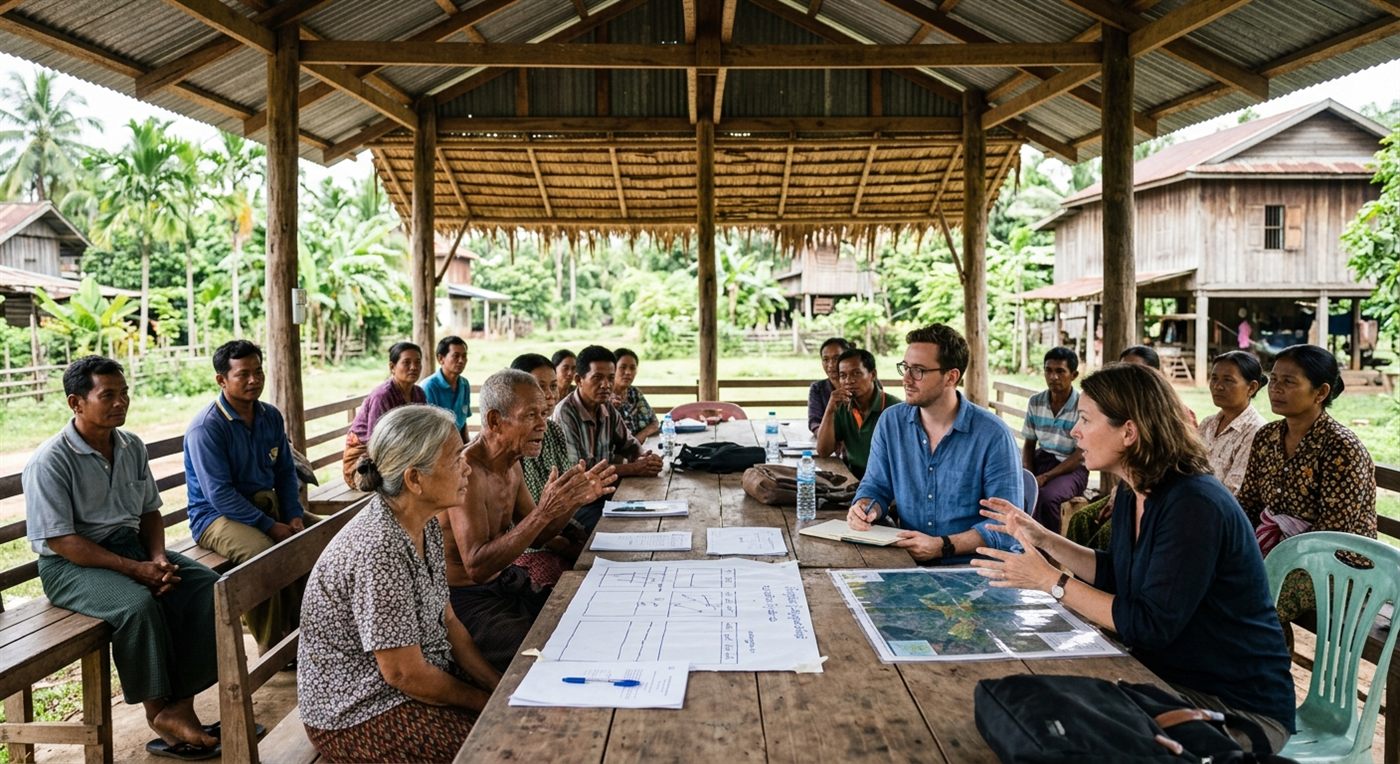
Partnerships that treat local context as a formality to be managed, a translator hired, a courtesy meeting held, tend to underperform those that treat it as information that should shape decisions from workforce composition to dispute resolution procedures to the specific structure of community benefit agreements. How a community expects to be consulted, who within a community holds the authority to give meaningful consent, and how disputes are traditionally resolved before they escalate to formal legal proceedings are all questions with answers specific to each place Domfar operates, and getting those answers wrong has derailed projects that were otherwise well planned on every technical dimension.
When Governments Change, What Survives
Every long-duration resource project will outlast at least one change in government, and often several. This is the clearest test of whether a relationship was built on genuine trust or on the personal rapport between specific individuals who eventually leave office. Domfar's experience is that relationships built on institutional transparency, consistent reporting, and demonstrated follow-through on commitments tend to survive leadership transitions far better than relationships built primarily on the personal goodwill of a single minister or official.
This has meant investing in relationships across multiple levels of government and multiple political factions, rather than concentrating engagement with whichever administration happens to be in power at a given moment. It is slower and requires more sustained effort than building a single strong relationship with a current government, but it is the only approach that has reliably protected project continuity when administrations change, which in the markets Domfar operates in, is a matter of when, not if.
Trust as Risk Management, Measured
The commercial case for all of this is straightforward, even if it resists easy quantification: trust reduces risk. Projects built on strong relationships absorb regulatory change, commodity price volatility, and operational setbacks far more easily than those held together purely by contractual leverage, because the other party has a stake in finding a solution rather than an incentive to exploit a moment of weakness. Domfar has, on more than one occasion, renegotiated terms with a government partner during a period of financial difficulty in a way that preserved the project for both sides, an outcome that would have been far less likely absent a relationship built over years of consistent, transparent dealing.
This is not a claim that trust eliminates risk. It is a claim, borne out across two decades of operating history, that trust changes how risk gets absorbed and resolved when it inevitably materializes, shifting outcomes from adversarial to collaborative in exactly the moments when that shift matters most.
The Long-Term Asset Framing
For Domfar, this has meant treating every partnership as a long-term asset in its own right, not simply the vehicle for a single transaction. That framing changes decisions that might otherwise be made purely on short-term economic logic. It means continuing to invest in a government relationship during a period when a specific project is dormant or delayed, because the relationship has value independent of that project's immediate status. It means maintaining community engagement commitments even during periods of low activity at a site, rather than treating engagement as an expense that can be paused when it is not urgently required.
Over time, this accumulation of relationship value has become, in a very real sense, one of Domfar's most durable competitive advantages, one that does not appear on a balance sheet but that has repeatedly determined which company gets access to the next opportunity in a market where the company has already demonstrated, over many years, that its word holds.
The Role of Local Partners and Joint Ventures
Nearly every long-term relationship Domfar has built in Southeast Asia and West Africa has run, at some point, through a local joint venture partner rather than a direct company-to-government relationship alone. This is not simply a regulatory formality required in markets that mandate local ownership stakes, though that requirement exists in many jurisdictions Domfar operates in. It reflects a genuine operating conviction that a credible local partner, one with standing in the community, relationships across government, and a stake in the project's long-term success rather than a short-term payout, is often the difference between a project that survives its first serious setback and one that does not.
Choosing that partner well is harder than it sounds, and Domfar has made mistakes in this area that shaped how the company evaluates potential partners today. A local partner selected primarily for political connections, without genuine community standing or a real operational contribution to make, tends to become a liability the moment those political connections shift, which they eventually do. The partners who have proven most durable over time are the ones who bring something beyond access: technical knowledge of local conditions, a workforce network built over years, or a track record of community engagement that predates any involvement with Domfar. Vetting for those qualities takes longer than vetting for connections alone, and it has consistently produced better outcomes.
Measuring Trust: What Domfar Tracks Internally
Trust resists easy quantification, but Domfar has, over time, developed a set of internal indicators that function as a reasonable proxy for the health of a given government or community relationship, tracked alongside the more conventional financial and operational metrics that any project reports. How quickly a government counterpart returns calls or responds to correspondence during a period of project difficulty is one signal. Whether community leaders bring concerns directly to site management or instead route them through public statements or formal complaints is another, since the former usually indicates an expectation that the concern will be heard and addressed, while the latter often indicates that trust in direct engagement has already broken down.
None of these indicators are perfect, and none of them substitute for the harder, more qualitative judgment that experienced country and community relations staff bring to assessing a relationship's real condition. But tracking them consistently across projects has given Domfar an early warning system that has, on several occasions, surfaced a deteriorating relationship well before it became visible in more conventional project metrics like permitting delays or community opposition to an expansion request, giving leadership time to intervene while the relationship was still repairable.
When Trust Fails: Lessons From the Exceptions
It would be misleading to present this approach as one that has worked without exception. Domfar has, over the course of two decades, walked away from at least a handful of opportunities where a government or local partner's conduct made continued engagement inconsistent with the company's own standards, and has lost access to at least one site following a change in regional leadership that no amount of prior relationship-building could have preserved, because the incoming administration's priorities had shifted in ways that had nothing to do with Domfar's own conduct.
These exceptions are instructive precisely because they clarify the limits of what a trust-based approach can guarantee. It cannot guarantee a favorable outcome in every case, and it should not be sold internally or externally as a formula that eliminates political risk. What it has consistently done is improve the odds, and shorten the recovery time when things do go wrong, because a company with a demonstrated track record of good-faith dealing tends to find a path back to the table even after a serious disruption, in a way that a company without that track record typically does not.
What This Looks Like Twenty Years In
Two decades into this approach, the clearest evidence of its value is not any single successful negotiation but the pattern across many of them: government partners who bring Domfar into early conversations about new opportunities before a formal tender process begins, communities that engage with new project proposals with a baseline of goodwill built from prior projects rather than the skepticism a new entrant would face, and a track record that makes the next partnership easier to build than the first one was. None of that shows up in a quarterly report. All of it shows up in which projects a company gets access to, and on what terms, over the long run that resource development actually operates on.
← Back to Field Notes